
Ahiṃsā – Nonviolence in Global Perspective
A Hamburg–Kyoto Partnership
The project “Ahiṃsā – Nonviolence in Global Perspective” is a blended-learning initiative jointly developed by the Faculty of Humanities at the University of Hamburg and the Faculty of Letters at Kyoto University. It brings together scholars, students, and civic partners to explore nonviolence not merely as a religious ideal, but as a globally relevant ethical framework.
Rooted in South Asian traditions – especially Jainism and Buddhism – ahiṃsā has shaped debates on compassion, environmental ethics, food practices, social justice, and political resistance. The project builds on Hamburg’s long-standing research tradition in Jain and Buddhist Studies while extending it into a transdisciplinary and transcultural dialogue that connects classical philology with contemporary global challenges.
Designed as a student-centered format, the program integrates digital learning, collaborative research, and intercultural exchange. Students from Indology, Religious Studies, Philosophy, Peace and Conflict Studies, Environmental Humanities, and related fields are invited to engage actively in shaping a shared academic discourse between Germany and Japan.
Project Leadership and Organization Hamburg
The project is initiated, conceived, and coordinated by Corinna May Lhoir (University of Hamburg). As a research associate, lecturer, and doctoral researcher in Jain Yoga and manuscript cultures, she brings together philological scholarship, international collaboration, and innovative teaching formats. She is responsible for the project’s conceptual framework, academic orientation, didactic design, and the coordination between Hamburg and Kyoto.
Prof. Dr. Michael Zimmermann (University of Hamburg) accompanies the project as academic patron. As Professor of Buddhist Studies and a long-standing bridge-builder between Hamburg and Japan, he contributes his expertise in Buddhist intellectual history as well as his extensive experience in German–Japanese academic cooperation.
Together, they represent a combination of institutional continuity and conceptual innovation.
Video production: Digital Learning Office of the Faculty of Humanities (uhh.de/gw-dl-buero)
Project Leadership and Organization Kyoto
The Kyoto component of the project is coordinated by Prof. Dr. Kyoko Amano, Professor of Indology at Kyoto University’s Graduate School of Letters. Trained in Freiburg and fluent in German, she embodies the intercultural foundation of this partnership. Her research focuses on Vedic philology and ritual studies, and she supports the development of the bilateral framework between Hamburg and Kyoto.
Ahimsa Lecture Series
The Ahimsa Lecture Series explores the concept of ahiṃsā (non-violence) in its historical, religious, philosophical, and societal dimensions. Bringing together an international and interdisciplinary group of speakers over the course of one semester, the series approaches ahiṃsā not merely as a religious or ethical ideal, but as a dynamic field of thought and practice in a global context. The aim of the lecture series is to connect academic research with critical reflection and contemporary societal relevance, fostering open discussion and dialogue among students, scholars, and an interested wider public.
All lectures take place in room ESA W 221; hybrid events will be live-streamed from there.
A brochure can be downloaded here.
Note on Schedule, Recordings, and Attendance
Please note that lecture times within the series vary: while several lectures take place from 6:15–7:45 pm, others – in particular the contributions from Japan – are scheduled earlier, from 8:15–09:45 am, due to time zone differences. Participants are therefore strongly advised to check the exact date, time, and location of each lecture in advance. All lectures will be recorded and made permanently available via Lecture2Go as well as on this website. The discussion sessions following the lectures will not be recorded, and live attendance is therefore strongly recommended in order to fully engage with the interactive and dialogical aspects of the series.
On-Site Module at Kyoto University (August 2026)
In August 2026, the project continues with an intensive on-site module at Kyoto University. Over five days, students will engage in advanced lectures and guided text readings in Sanskrit and Prakrit, followed by a two-day academic symposium.
The Kyoto component integrates academic study with civic and cultural engagement. Planned activities include visits to the Jain temple in Kobe, the Kyoto Museum for World Peace, and optional contemplative encounters within Japanese Buddhist contexts. Students will present their collaborative projects and receive joint certification from both universities.
Together, the Hamburg lecture series and the Kyoto Summer School establish a sustainable framework for long-term cooperation. The 2026 focus on ahiṃsā marks the beginning of a thematic cycle that will continue with further ethical concepts from South Asian traditions in the coming years.
Venue of the lecture series at University of Hamburg: ESA W 221
Please klick (+) to expand for lecture abstract, bio and a lecture recording plus additional material (as soon as available)
08.04.26 (18:15 Uhr) Piotr Balcerowicz: "The Origins of Ahimsa in the Indian Context"
The Origins of Ahimsa in the Indian Context
April 08, 2026, 6:15 pm, Asia-Africa-Institute, West Wing (ESA W 221) and online.
Material:
The Origins of Ahiṃsā in the Indian Context – Revised and Author-Approved Lecture Text
Recording:
The talk addresses the complex origins of ahiṃsā and non-injury (non-harmfulness, non-violence), in India, both being fundamental in Indian systems of values and morality. On the one hand, the term ahiṁsā did not, when it was used for the first time, connote all-encompassing non-injury and its meaning was very restricted. On the other hand, the idea of unequivocal non-injury to all living beings, not only humans, was developed in rather different religious and intellectual circles. It was only later that these two ideas – ahiṁsā and non-violence – merged and became mostly interchangeable. Both seem to be a result of mutual inspiration between various religious systems, such as early Vedic Brahmanism, Ajivikism, Jainism and Buddhism.

Piotr Balcerowicz is Professor of Indian Philosophy at the Faculty of Asian and African Cultures, University of Warsaw, and a leading specialist in South Asian intellectual history, with a particular focus on Jainism and classical Indian logic and epistemology. He received his PhD from the University of Hamburg and completed his habilitation at the Polish Academy of Sciences. Beyond academia, he founded and led the NGO “Education for Peace,” dedicated to education initiatives in conflict-affected regions, and has also worked in international contexts (incl. UN-related teaching and outreach).
15.04.26 (18:15 Uhr) Michael Zimmermann: "Ahimsa zwischen Ideal und Rhetorik: Was Buddhisten mit Gewaltlosigkeit meinen"
Ahimsa zwischen Ideal und Rhetorik: Was Buddhisten mit Gewaltlosigkeit meinen
15. April 2026, 18:15 Uhr, AAI, Westflügel (ESA W 221) und online, für die Online-Teilnahme bitte hier registrieren.
Recording:
Der Vortrag widmet sich einer Analyse der Stellung des Konzepts von Ahimsa innerhalb des buddhistischen Lehr- und Normengefüges sowie der Frage nach dessen normativen und praktischen Implikationen für die Lebensführung in buddhistisch geprägten Gesellschaften in historischer wie gegenwärtiger Perspektive. Exemplarisch werden dabei unter anderem ethische Diskurse zur Mensch-Tier-Beziehung sowie die Relevanz buddhistischer Positionen für politische Entscheidungsprozesse im Kontext von Krieg und Frieden thematisiert.
Anhand dieser Analyse wird erkennbar werden, dass die buddhistische Lebenswirklichkeit – entgegen einer häufig normativ überhöhten Rhetorik – durch eine eher pragmatische Orientierung geprägt ist. Dies wird insbesondere ersichtlich im Rahmen einer strukturellen Differenzierung: Die striktere Anwendung von Ahimsa-Prinzipien findet sich im privaten bzw. individuellen Handlungsbereich. Eine deutlich flexiblere, teils relativierte oder sogar suspendierte Umsetzung entsprechender normativer Vorgaben herrscht dagegen im öffentlichen und politischen Kontext vor.

Michael Zimmermann studierte Indologie, Tibetologie und Japanologie in Hamburg und promovierte zum Ursprung der Lehre von der Buddhanatur in Indien. Forschungsaufenthalte führten ihn u. a. nach Kyoto, Tokyo und Kathmandu. Nach Stationen an der Stanford University (USA) ist er seit 2007 Professor für indischen Buddhismus am Asien-Afrika-Institut der Universität Hamburg und Co-Direktor des Numata Zentrum für Buddhismuskunde. Seine Forschungsschwerpunkte liegen im indischen Mahāyāna-Buddhismus, der textgeschichtlichen Arbeit mit indischen, tibetischen und chinesischen Quellen sowie in Fragen buddhistischer Ethik, insbesondere zu Politik und Gewalt.
22.04.26 (08:15 Uhr) Yutaka Kawasaki: "Ahimsa in Jainism: Principles, Practice, and Philosophical Depth"
Ahiṃsā in Jainism: Ideals and Reality
April 22, 2026, 8:15 am, Asia-Africa-Institute, West Wing (ESA W 221) and online, for online participation please register here.
Recording:
This lecture introduces Jainism and explores its core ethical principle, Ahiṃsā (non-violence), through the dual lens of “ideals” and “reality.” While the ideal demands total non-injury toward all life—including plants and the four elements (earth, water, fire, and air)—practicality requires complex adaptation. We will examine how Jainism navigates these tensions via three case studies: the status of elements as living beings, violence in ritual worship, and the ethics of religious suicide. Time permitting, the Jain perspective on war will also be briefly touched upon.
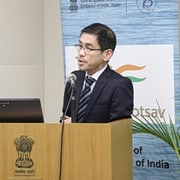 Yutaka Kawasaki is an Assistant Professor at the Asian Research Library (the University of Tokyo) specializing in Jainism and Early Buddhism. His research focuses on the monastic’s disciplines in mediaeval Jainism and works by Haribhadrasūri.
29.04.26 RECORDING ONLY Samani Pratibha Pragya "Ahimsa in Practice: Spiritual and Ethical Dimensions of Nonviolence"
Ahimsa in Practice: Spiritual and Ethical Dimensions of Nonviolence
Please note: This lecture has been postphoned until further notice and will be made available as a recording. There will be no live online session and no on-site meeting in the lecture hall on April 29. Registered participants will be informed as soon as the recording is available.
Please register here.
This lecture explores ahiṃsā not only as a philosophical ideal, but as a lived ethical and spiritual practice within the Jain tradition. Drawing on her experience as a Jain nun and teacher, Samani Pratibha Pragya introduces the practical dimensions of nonviolence as they are cultivated in everyday conduct, spiritual discipline, and social interaction.
The lecture will address how ahiṃsā is embodied through mindfulness, restraint, compassion, and responsibility, and how these practices relate to contemporary ethical challenges. Rather than focusing on abstract doctrine alone, the talk highlights ahiṃsā as a dynamic practice that connects inner transformation with outward action.
By combining spiritual reflection with ethical insight, the lecture offers an accessible introduction to Jain perspectives on nonviolence that is relevant both within and beyond religious contexts.

Dr Samani Pratibha Pragya is a scholar of Jain Studies and her specialisms include Jain Yoga, Comparative Religion, Comparative Philosophy, Meditation & Spirituality, Nonviolence, Sanskrit, Prakrit, Hindi Languages, and Jain Terapanth lineage, to which she belongs as a Samani (saint). She is a senior disciple of Acharya Mahashraman. Her current research centers on the history and methods of modern Jain meditation and yoga.
She received her Ph.D. in “Prekṣā Meditation: History and Methods” from SOAS. At present, she is working as a Visiting Research Fellow at SOAS with Dr. Flügel on Terapanth data pertaining to the Jaina-Prosopography project. She had established JVB Jain World Peace Centre, London. At present, she is the spiritual head of it and is an authorized Prekṣā yoga and meditation teacher. She initiated a rural development project at Tamkore, Rajasthan, and established Mahapragya International School there. She worked for underprivileged girls’ education in Jhunjhunu district.
04.05.26 (18:15 Uhr) Sebastian Nehrdich: "Access as Nonviolence: Designing DH Platforms That Reduce Inequality"
Access as Nonviolence: Designing DH Platforms That Reduce Inequality
May 04, 2026, 6:15 pm, Asia-Africa-Institute, West Wing (ESA W 221) and online, for online participation please register here.
Recording:
We are living in an age where an ever-increasing amount of digitally available data and rapidly advancing AI tools are fundamentally changing the way research on textual material of Asian traditions is undertaken. This fundamental transition holds clear dangers: AI systems are, in many respects, systems that amplify existing trends and patterns in the data they are trained on, and the profit-oriented nature of the companies behind the most popular applications raises serious questions about their trustworthiness when it comes to adequate knowledge representation. In this talk, I will examine how Digital Humanities and AI can function as a bridge to reduce bias and inequality, and how crucial the development of independent, transparent systems with openly accessible datasets is for ensuring a positive impact of these technologies on scholarship. Framing non-violence (ahiṃsā) as a practical concern for research infrastructures, I argue that “doing less harm” in this context means building tools that broaden access while making their assumptions, sources, and limitations visible.
 Sebastian Nehrdich is a tenure-track Assistant Professor at Tohoku University. He completed his PhD in Computational Linguistics at the University of Düsseldorf, co-supervised by Oliver Hellwig and Kurt Keutzer. He holds an MA in Buddhist Studies from the University of Hamburg. His work integrates digital philology, Buddhist textual analysis, and machine learning. He serves as Director of the Dharmamitra project that was founded at the Berkeley AI Research Lab (BAIR).
06.05.26 (08:15 Uhr) Priyadarshana Jain: "Philosophical Foundations of Ahimsa and Their Relevance for Jain Education and Contemporary Life"
Philosophical Foundations of Ahimsa and Their Relevance for Jain Education and Contemporary Life
May 06, 2026, 8:15 am, Asia-Africa-Institute, West Wing (ESA W 221) and online, for online participation please register here.
Recording:
Ahimsa (non-violence) constitutes the central ethical and metaphysical principle of Jain philosophy, grounded in the doctrines of jīva, karma, and rebirth - all to be understood first through the lens of Anekantavada. This lecture examines the philosophical foundations of ahimsa as articulated in classical Jain texts such as the Tattvārtha Sūtra and Ācārāṅga Sūtra. It further explores how ahimsa operates not merely as moral restraint but as a disciplined mode of cognition and conduct learnt through holistic education. The relevance of ahimsa is discussed in the context of contemporary challenges such as ecological crisis, violence, education ethics, and global coexistence. The lecture highlights Jain education as a transformative framework integrating philosophy, ethics, and lived practices.

Dr. Priyadarshana Jain is a scholar of Jain philosophy and Comparative Religions, with research interests in Jain Metaphysics, Consciousness Studies, and Applied Spirituality. A practicing Jain, she has contributed extensively to academic discourse on Jain metaphysics and non-violence, and actively engages in interdisciplinary dialogue linking classical Jain thought with contemporary global concerns.
20.05.26 (18:15 Uhr) Claire Maes: "Non-Violence and the Jain Fast to Death: Legal and Bioethical Debates"
Non-Violence and the Jain Fast to Death: Legal and Bioethical Debates
May 20, 2026, 6:15 pm, Asia-Africa-Institute, West Wing (ESA W 221) and online, for online participation please register here.
In 2006, human rights activist Nikhil Soni filed a public interest litigation (PIL) in the Rajasthan High Court to outlaw the Jain practice of fasting to death (sallekhanā). There are various and contested definitions of sallekhanā, but a common, contemporary Jain understanding explains sallekhanā as a religious act, an exercise of self-purification, a vow of meditation which involves the gradual giving up of food and water. Soni, however, argued that it should be criminalized on social, bioethical, and human-rights grounds. To the great dismay of the Jain community, the court equated sallekhanā with suicide and, on 10 August 2015, banned both the practice and its abetment. Jains responded with special leave petitions to the Supreme Court, which on 31 August 2015 stayed the order, temporarily restoring their right to perform sallekhanā.
In this lecture, I examine this contemporary legal debate surrounding the Jain fast to death and ask what happens when competing worldviews and value systems enter the courtroom. For Jains, suicide is antithetical to sallekhanā, which they regard as the highest expression of non-violence (ahiṃsā), whereas critics frame it as a violation of human rights. By comparing sallekhanā with other end-of-life options, such as Voluntary Stopping of Eating and Drinking (VSED), we will explore their key similarities and differences and consider what this Jain practice can contribute to contemporary bioethical debates on death and dying.

Claire Maes is Assistant Professor of Indology at the University of Tübingen. She earned her Ph.D. from Ghent University and held a Postdoctoral Fellowship from The Robert H. N. Ho Family Foundation Program in Buddhist Studies at the University of Texas at Austin. Her research focuses on Indian Buddhism and Jainism, and she is currently writing a monograph on the Jain practice of fasting to death (sallekhanā). Her recent publications include “Gossip and Rumour in the Pali Canon” (2025), “Anger and Defamation in the Theravāda Vinaya” (2024), and “Sallekhanā and the End-of-Life Option of Voluntarily Stopping Eating and Drinking” (2023), recipient of the Bhagwan Kunthunath Award for the best research paper in Jainism in 2025.
03.06.26 (18:15 Uhr) Corinna May Lhoir: "Wer spricht hier von Ahiṃsā? Zur Interpretation von Gewaltlosigkeit in yogischen Texttraditionen"
Wer spricht hier von Ahiṃsā? Zur Interpretation von Gewaltlosigkeit in yogischen Texttraditionen
03. Juni 2026, 18:15 Uhr, AAI, Westflügel (ESA W 221) und online, für die Online-Registrierung bitte hier anmelden.
Recording:
Der Begriff ahiṃsā (Gewaltlosigkeit) gilt als zentrales ethisches Ideal sowohl im Yoga als auch im Jainismus. Doch was genau ist damit gemeint, und wer definiert seine Bedeutung? Die Vorlesung geht dieser Frage anhand klassischer yogischer Texte nach, insbesondere der Yogasūtras Patañjalis (2.30, 2.31 und 2.35), und verfolgt, wie ahiṃsā dort zunächst als ethische Disziplin (yama), dann als universales Gelübde (mahāvrata) und schließlich als wirksame Praxis beschrieben wird. Besonderes Augenmerk gilt den unterschiedlichen Stimmen innerhalb der yogischen Texttraditionen selbst: Neben frühen Kommentaren werden auch spätere jainische Auslegungen herangezogen, die die Yogasūtras aus einer eigenen ethisch-religiösen Perspektive neu lesen. Die Vorlesung zeigt, dass ahiṃsā kein einheitlicher, zeitlos festgelegter Begriff ist, sondern ein interpretatives Feld, in dem sich unterschiedliche Vorstellungen von Ethik, Praxis und Befreiung überlagern und miteinander in Dialog treten.
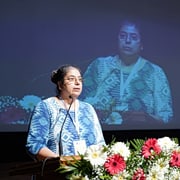
Corinna May Lhoir ist klassisch-philologisch ausgebildete Indologin und Doktorandin am Centre for the Study of Manuscript Cultures der Universität Hamburg. Ihre Forschungsschwerpunkte sind mittelalterlicher Jaina-Yoga sowie die Geschichte von Yoga und Meditation. Sie promoviert derzeit an den Universitäten Hamburg und Gent mit einer Dissertation zum Yogapradīpa, bestehend aus einer kritischen Edition und kommentierten Übersetzung auf der Grundlage mehrsprachiger jainistischer Handschriften, mit besonderem Fokus auf ethische und soteriologische Deutungsrahmen.
10.06.26 (18:15 Uhr) Asoka Bandarage: "Nonviolence and Existential Crisis: Towards Ecological Sustainability and Economic Justice"
Nonviolence and Existential Crisis: Towards Ecological Sustainability and Economic Justice
June 10, 2026, 6:15 pm, Asia-Africa-Institute, West Wing (ESA W 221) and online, for online participation please register here.
Recording:
Materialist development and the adulation of individualism and competition have undermined the inherent values of human evolution, namely altruism, compassion and cooperation. They have given rise to violence, political and economic extremism and ecological and social destruction. It is vital that we evolve beyond the resultant isolation, powerlessness and resignation of this destructive worldview. How can we move towards a broader ethical and social framework and a non-violent, balanced path of environmental sustainability and human
well-being? Drawing upon the Buddha’s teaching as well as other perspectives on ecological and social justice, this lecture will explore how altruism—as a defining value of human evolution—can inform socio-economic systems and address political and economic extremism and global violence.

Asoka Bandarage has an M.A. in Religion and a Ph.D. in Sociology from Yale University. She has served on the faculties of Brandeis University, Georgetown University and Mount Holyoke where she received tenure. Prof. Bandarage is the author of books: Colonialism in Sri Lanka (De Gruyter); Women, Population and Global Crisis (Zed Books); The Separatist Conflict in Sri Lanka (Routledge); Sustainability and Well-Being: The Middle Path to Environment, Society and the Economy (Palgrave MacMillan); Crisis in Sri Lanka and the World: Colonial and Neoliberal Origins: Ecological and Collective Alternatives (De Gruyter) and other publications on political-economy, ecology, ethno-religious conflict as well as mindfulness and social action. She currently serves on the Advisory Boards of Critical Asian Studies, and Interfaith Moral Action on Climate. www.bandarage.com
17.06.26 (18:15 Uhr) Maria Rosa Lehmann: "Praktiken gewaltlosen Widerstands: Yoko Ono, Kunstaktionen und politischer Protest in den 1960er und 1970er Jahren"
Praktiken gewaltlosen Widerstands: Yoko Ono, Kunstaktionen und politischer Protest in den 1960er und 1970er Jahren
17. Juni 2026, 18:15 Uhr, Asien-Afrika-Institut, Westflügel (ESA W 221) und online, für Online-Anmeldung bitte hier klicken
Recording:
Dieser Vortrag versteht künstlerische Aktionen der 1960er und 1970er Jahre als Bestandteil eines erweiterten Feldes gewaltlosen Widerstands. Er untersucht ihre strukturellen und strategischen Verbindungen zu zeitgenössischen politischen Praktiken wie Sit-ins, Friedensmärschen und Protesten des Civil Rights Movements. Statt Performancekunst als bloßen symbolischen Kommentar zu verstehen, untersucht der Vortrag ausgewählte Kunstaktionen als Handlungen, die mit ähnlichen Strategien arbeiten wie politischer Protest: körperliche Exponierung, Zurückhaltung, Nicht-Kooperation und die gezielte Eskalation ethischer Spannung.
Yoko Ono dient dabei als zentraler Referenzpunkt, jedoch nicht als alleiniger Fokus. Werke wie Cut Piece werden nicht als isolierte künstlerische Provokationen analysiert, sondern als Aktionen, die mit anderen künstlerischen Positionen und gewaltlosen politischen Aktionen in Resonanz stehen. Sie fungieren als strukturell vergleichbare Formen des Eingriffs und nicht als Metaphern. In beiden Fällen setzen die Beteiligten ihre Körper einem Risiko aus, während sie eine gewaltsame Reaktion verweigern. Macht wird nicht direkt konfrontiert. Sie wird verunsichert.
Durch die Gegenüberstellung künstlerischer und politischer Aktionen arbeitet der Vortrag gemeinsame Methoden und praktische Zielsetzungen heraus. Dazu gehören die Neukonfiguration von Handlungsmacht, die Störung dominanter Machtverhältnisse sowie die Aktivierung des Publikums als verantwortliche Beteiligte statt als passive Beobachter.

Maria Rosa Lehmann is an art historian and data modeler working at the intersection of modern art and performance studies, archival research, and computational methods. She completed her PhD on surrealist performance at the Université Sorbonne-Panthéon (2018), supported by Labex CAP and Brown University. She has held postdoctoral fellowships at Cornell University, the Université du Québec à Montréal (UQAM), and the German Forum for Art History (DFK) in Paris. She has taught liberal arts, art history, and French in a range of academic and educational settings and has been involved in several curatorial and exhibition projects, among them Ceci n’est pas un musée at the Fondation Maeght (2014) and Une brève histoire de l’avenir at the Louvre Museum (2015).
Alongside her historical work, she has developed extensive experience in data modeling and digital humanities infrastructure. She is currently completing a B.Sc. in Computer Science with a focus on relational database design, Python-based OCR pipelines, conceptual modeling, and large-scale research databases built in SQL/MySQL. She applies software engineering methods to art-historical analysis, developing analytic tools and algorithmic workflows that help identify patterns and classify sources. Her technical practice includes building REST APIs in Go (Golang) to structure research data and support reproducible analytical environments. Her projects draw on open standards such as CIDOC CRM and emphasize sustainability, interoperability, and transparent documentation rather than short-lived academic software ecosystems.
Her current projects include a monographic study on Quebecois artist Mimi Parent for the Art Canada Institute and a web-based platform for large-scale analysis of artistic reception across historical press archives. She is also preparing a series of lectures for the Universitat Autònoma de Barcelona on neural radiance fields, Gaussian splatting, and their applications in cultural heritage.
Her artistic practice moves between drawing, installation, and performance, exploring embodiment and the fragile exchanges between humans and machines. Since 2020, she has worked extensively in sequential art and techno-futurist graphic narratives. Recent projects combine hand-drawn comics digitized through CZUR workflows with robotics-based art in which autonomous devices create unique visual works, integrating circuit design, Arduino programming, and sensor systems.
Across her work, she is committed to bridging art-historical research with computational thinking. Her long-term interest lies in contributing to a new academic curriculum in which art history and computer science are taught together, enabling future scholars to build the tools their discipline requires rather than adapting those of other fields.
24.06.26 (08:15 Uhr) Shinya Yamamoto: "The Evolution of Human Nature, Group-mindedness, and Nonviolence: A Comparative Perspective"
The Evolution of Human Nature, Group-mindedness, and Nonviolence: A Comparative Perspective
June 24, 2026, 8:15 am, Asia-Africa-Institute, West Wing (ESA W 221) and online, for online participation please register here.
Recording:
In an era marked by global conflict, understanding the evolutionary roots of human nature is essential for fostering a peaceful, coexisting society. This lecture explores these roots through a comparative behavioral lens, focusing mainly on our closest living relatives: chimpanzees and bonobos. Despite being sister species, they exhibit strikingly different social dynamics; chimpanzees are known for intense intergroup hostility, while bonobos demonstrate a remarkable capacity for peaceful coexistence with out-group members. I will introduce key hypotheses regarding the evolutionary divergence of these two species, highlighting "cooperation" and "group-mindedness" as central themes. While cooperation is often celebrated as a uniquely human virtue, this talk proposes a more nuanced perspective: that ingroup cooperation and outgroup competition are often two sides of the same evolutionary coin. By re-evaluating these traits, we can better understand the biological foundations of group identity and the potential for nonviolence in the modern human experience.
 Through both cognitive lab research and fieldwork, I am tackling the mysteries of the evolution of sociality and intelligence through various animals such as chimpanzees and bonobos, as well as humans ourselves. The ultimate research theme is to understand what it means to be human; the evolution of human nature: we look at its past as well as its future. In particular, I am interested in social intelligence, which is the intelligence exhibited for group living, and my main keywords are empathy, bond formation, cooperation, culture, and collective society with group-mindedness. In recent years, we have further expanded the range of target animals (including humans) and are making practical efforts toward the realization of a better harmonious society between humans and non-human animals.
Shinya Yamamoto is a Professor at the Kyoto University Institute for the Future of Human Society (IFoHS)
24.06.26 (18:15 Uhr) Jeffery D. Long: "Gandhi and the Jain Roots of Nonviolence"
Gandhi and the Jain Roots of Nonviolence
June 24, 2026, 6:15 pm, Asia-Africa-Institute, West Wing (ESA W 221) and online, for online participation please register here.
Recording:
This lecture will explore the close philosophical and historical connections between Mohandas K. Gandhi’s practice of ahiṃsā and the Jain tradition. Although it is less known in the Western world than the Hindu and Buddhist traditions, to which it is closely related, the impact of Jain thought and practice on Indian culture as a whole has been tremendous. Gandhi, in particular, grew up in a region of India–Gujarat–with a prominent Jain presence, and in adulthood he would befriend Rajchandra Mehta, a major Jain thinker of the modern period to whom Gandhi looked as a mentor. Gandhi would transform the Jain practice of ahiṃsā–nonviolence in thought, word, and action–from a personal spiritual orientation aimed at liberation from the cycle of rebirth to a political tool for achieving India’s national independence from colonial rule. All of these varied connections will be traced and summarized in this lecture.

Jeffery D. Long is the Carl W. Zeigler Professor of Religion, Philosophy, and Asian Studies at Elizabethtown College, where has taught since receiving his doctoral degree from the University of Chicago Divinity School in the year 2000. He has written numerous books and articles and has also spoken at the United Nations, as well as appearing in documentaries for the History Channel and the Public Broadcasting Service. In 2022 he received an award from the International Ahimsa Foundation, in New York, for his efforts to promote nonviolence through his scholarship.
29.06.26 (18:15 Uhr) Shrinetra Pandey: "Ahimsa - Jain Way of Life"
Ahimsa - Jain Way of Life
June 29, 2026, 6:15 pm, Asia-Africa-Institute, West Wing (ESA W 221) and online, for online participation please register here.
Recording:
The talk highlights nonviolence as the central pillar of Jain philosophy and practice. Rooted in the teachings of the 24 Tīrthaṅkaras, Jainism emphasizes ahiṁsā as not hurting any living being by actions of mind, speech, and body done by self, making others do, and by appraising others’ acts. Ahiṁsā is applied universally, from one-sensed organisms such as plants and elements to five-sensed beings like humans and animals, affirming the equality and dignity of all souls. The talk includes nonviolent food practices, abstention from alcohol, honey, and certain fruits, as well as moral restraint from vices such as gambling, hunting, and theft as practical applications of ahiṁsā. In Jainism, ahiṁsā is presented not merely as avoidance of harm but as a holistic way of life. It embodies forgiveness, compassion, kindness, tolerance, and equanimity, offering a universal code of conduct that fosters peace, equality, and spiritual progress.

Shrinetra Pandey is Director of the International School for Jain Studies (ISJS), Pune. He holds a PhD in Philosophy from Banaras Hindu University, Varanasi, and has been awarded fellowships by the Indian Council of Philosophical Research (ICPR) and the Ministry of Culture, Government of India. An accomplished scholar and editor, he is the editor of ISJS-Transactions and has organized numerous national and international seminars on Jainism. He has co-authored and edited works including Sacred Thread – Patanjali’s Yogasutra (2021), Determinism in Shramanic Traditions (2022), and Jainism Before 650 BCE (2022). At ISJS, he organises international residential summer schools for experiential studies of Jainism and serves as the project director of the English translation of Paia-Sadda-Mahannavo. He also serves as Vice Chair of the regulating council of the Bhagwan Shitalnath Chair for Jain Archaeology at Deccan College, the world’s first academic chair dedicated exclusively to Jain archaeology.
15.07.26 (08:15 Uhr) Somadeva Vasudeva: "Ahiṃsā in Non-Dualist Śaivism"
Ahiṃsā in Non-Dualist Śaivism
July 15, 2026, 8:15 am, Asia-Africa-Institute, West Wing (ESA W 221) and online, for online participation please register here.
Although violent intent (hiṃsā) is inherently rejected as a legitimate justification in the non-dualist Śaiva apologia of even extreme ritual violence (na hiṃsābuddhim ādadhyāt), non-violence (ahiṃsā) itself neither constitutes an absolute principle nor an absolute moral imperative.
In various contexts, including yogic meditation, non-dualist Śaivas contend that ahiṃsā and other prosocial virtues cannot directly contribute to the soteriological attainment of liberated consciousness (saṃvitti). Various Śaktis, as operational aspects of a pure non-dual consciousness, act with intent that may not always appear to be benevolent. Instead, they frequently function as agents of karmic retribution, employing violence to ensure karmic justice.
Ultimately, the tension between violence and non-violence is resolved through a non-dualist doctrine of unimpeded autonomy (svātantryavāda).
 Somadeva Vasudeva received his PhD from Oxford University for work on the Yoga of the Mālinīvijayottara Tantra in 2000. Since then he has been a Postdoctoral Researcher at the École française d’Extrême-Orient in Pondicherry in South India and has held Sanskrit teaching positions at UC Berkeley, at Columbia University in New York, and Kyoto University in Japan. He is currently Professor of Indian Philosophy and Transcultural Studies at Kyoto University in Japan. His main areas of research are Theistic Yoga, Sanskrit Philosophy, Poetry and Aesthetics